As 2012 comes to a close, it's time for our 12th annual Year-End Zeitgeist—an in-depth look at the "spirit of the times" as seen through the billions of searches on Google over the past year.
On our 2012 Zeitgeist website, you can explore the most popular and hottest trending search terms from around the world. This year’s site is our most global to date, with a total of 838 lists from 55 countries. We’ve also added a number of new features, including an interactive map that shows where and when some of the hottest terms spiked around the world, and a Google Zeitgeist Android app coming out later today (with an iOS version coming soon too).
For a round-the-globe tour through 2012, take a look at our video:
So what kinds of things were top of mind this year? While there are perennial themes—“what is love?” topped the list in 10 countries—it’s the unusual and surprising that caught our attention in 2012.
Global superstar Whitney Houston topped many countries’ lists as well as three of our overall trending lists—her unexpected death surprising fans around the world. From Korea, YouTube sensation PSY’s “Gangnam Style” signature dance took the world by storm, landing him the #1 spot in many countries and making his song the second most trending query of 2012. (PSY’s video became the #1 most watched in YouTube history—stay tuned for YouTube’s Rewind for more.)
Then there was the superhuman. Austrian skydiver Felix Baumgartner’s epic free fall jump made him the #6 globally trending person of the year, while the 2012 Olympics and its various athletes made it into almost every country’s top trends. And NBA player Jeremy Lin also rose on the charts this year, making him the #1 trending athlete globally.
People researched a breadth of other topics, too. Web users took a serious interest in threats to the open Internet, with proposals like SOPA and ACTA both finding their way to the top of many countries’ lists. The U.S. elections brought attention to the candidates and issues, not least the presidential campaigns’ most notorious political gaffes. And while it might not be surprising to see that tragic natural disasters like Hurricane Sandy ranked highly (#3 on the global trending list), it is reassuring to find searches like [donate to Sandy] spiking as well.
We hope you enjoy exploring what people around the world were searching for in 2012. It’s quite a snapshot of what makes us human: a blend of guilty pleasures and higher pursuits.
Wednesday, 12 December 2012
Wednesday, 5 December 2012
Quick answers to resolve holiday travel stress
It’s easy to have a love-hate relationship with the holidays. On the one hand, it’s a joyous time of the year full of festivities and delicious baked goods. On the other hand, it’s stressful. For something like traveling which is already stressful on its own, traveling during the holidays can feel like twice the trouble.
One way to cut down on some of the stress before you head to the airport is to plan ahead. Let’s say this year you’re traveling to France for the holidays. Here are some quick answers that can make your planning faster and easier -- we recently redesigned these features to be richer and more interactive on mobile and tablet, and now you’ll see them on desktop as well, so you can plan ahead whether you’re at home or on the go:
Other quick answers we’re updating on desktop over the next few weeks are finance, unit conversion, holiday and sunrise times, and weather. And, of course, you can also make your holidays easier to manage using things like our Flight Search feature to book your trip, Google+ to share your photos with family and friends, Google Docs to track your holiday spending, and more.
Happy holidays!
Posted by Robert Stacey, Software Engineer
One way to cut down on some of the stress before you head to the airport is to plan ahead. Let’s say this year you’re traveling to France for the holidays. Here are some quick answers that can make your planning faster and easier -- we recently redesigned these features to be richer and more interactive on mobile and tablet, and now you’ll see them on desktop as well, so you can plan ahead whether you’re at home or on the go:
- Figure out your budget. Since luggage space is limited and you don’t want to pay an overage fee, you may want to buy your gifts when you land in France. Find the currency exchange rate ahead of time so you can figure out how much that $15 (USD) fruitcake actually costs in euros by searching [15 usd in euro] or [french currency].
- Learn about French traditions. Friends who live in Paris have invited you to their reveillon dinner. Trouble is, you don’t know what that means. You can quickly find the answer by typing [define reveillon] in Google.
- Plan your holiday Hangouts. Even though you’ll be oceans apart, you can still wish your family a happy holidays in person. Schedule a date for a Google+ Hangout, but don’t forget to factor in the time difference, which you can figure out by searching [time in france].
- Track your flight before you leave the house. To avoid arriving at the airport only to find out your flight’s been delayed for hours, you can quickly check the flight status by typing the flight number like [united airlines 942] or [UA942], into the search box.
Happy holidays!
Posted by Robert Stacey, Software Engineer
Tuesday, 4 December 2012
Get smarter answers from the Knowledge Graph from Português to 日本語 to русский
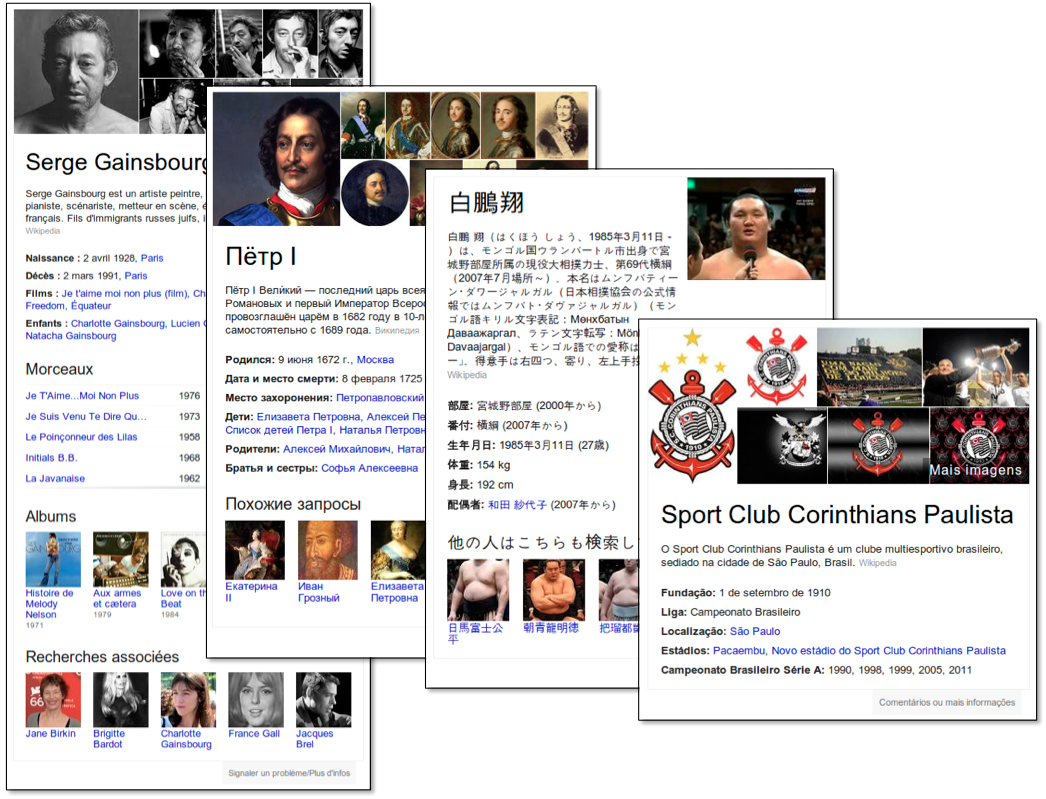
Over the next few days, when you search in Spanish, French, German, Portuguese, Japanese, Russian, or Italian, you’ll start seeing new answers from the Knowledge Graph -- our project to map out real-world things as diverse as movies, bridges and planets. You can now quickly and easily discover new information relevant to your language and country.
So in Japanese, your search for [白鵬] will bring up the top-ranked sumo wrestler, including his heya and ranks, and help you discover other highly-ranked sumo wrestlers. Or a Russian search for [петр I] will help you research the country’s historic Tzar Peter the Great, and explore connections to his family and other famous rulers. And if you’re a fan of football in Brazil, [corinthians] will show information including that team’s most recent championship wins -- all in your language.

This is more than just translation. The Knowledge Graph needs to account for different meanings of the same word -- “football” means something quite different in the U.S. than in Europe. It also needs to recognize what's most important in a particular region. The graph now covers 570 million entities, 18 billion facts and connections, and about three times as many queries globally as when we first launched it -- we’ll keep working on making it more useful for you.
Posted by Aaron Brown, Senior Product Manager, Search
So in Japanese, your search for [白鵬] will bring up the top-ranked sumo wrestler, including his heya and ranks, and help you discover other highly-ranked sumo wrestlers. Or a Russian search for [петр I] will help you research the country’s historic Tzar Peter the Great, and explore connections to his family and other famous rulers. And if you’re a fan of football in Brazil, [corinthians] will show information including that team’s most recent championship wins -- all in your language.
This is more than just translation. The Knowledge Graph needs to account for different meanings of the same word -- “football” means something quite different in the U.S. than in Europe. It also needs to recognize what's most important in a particular region. The graph now covers 570 million entities, 18 billion facts and connections, and about three times as many queries globally as when we first launched it -- we’ll keep working on making it more useful for you.
Posted by Aaron Brown, Senior Product Manager, Search
Friday, 30 November 2012
Look up medications more quickly and easily on Google
We get a lot of queries for medicine on Google. So to make it quick and easy for you to learn about medications, we’ll start showing key facts -- side effects, related medications, links to in-depth resources, and more -- right on the search results page.

This data comes from the U.S. FDA, the National Library of Medicine, and the Department of Veterans Affairs, among others. It’s part of the Knowledge Graph -- our project to map out billions of real-world things, from famous artists to roller coasters to planets (and now medications). We hope you find this useful, but remember that these results do not act as medical advice.
Posted by Aaron Brown, Senior Product Manager, Search
Tuesday, 6 November 2012
Spiffing up your search results page
You’ll notice a new simpler, cleaner design on the search results page — we’ve been working on ways to create a consistent search experience across the wide variety of devices and screen sizes people use today. We started with tablets last year, got it to mobile phones a few weeks ago, and are now rolling out to the desktop.
With the new design, there’s a bit more breathing room, and more focus on the answers you’re looking for, whether from web results or from a feature like the Knowledge Graph:
The same advanced tools you’re used to are still there when you need them. Just click on “Search tools” to filter or drill down on your results:
Posted by Jon Wiley, Lead Designer, Google Search
With the new design, there’s a bit more breathing room, and more focus on the answers you’re looking for, whether from web results or from a feature like the Knowledge Graph:
The same advanced tools you’re used to are still there when you need them. Just click on “Search tools” to filter or drill down on your results:
It’s going out to Google.com users in the U.S. to start, and we want to get it to users in other languages and regions as soon as we can. We hope you enjoy this design refresh — let us know what you think on our Google+ page.
Posted by Jon Wiley, Lead Designer, Google Search
Friday, 26 October 2012
Get your Google back
If you’ve moved to Windows 8 and are getting acquainted with it, you may be looking for a couple of your favorite Google products that you use every day. To help you get the best experience possible on Google and across the web, we’ve designed and built a new Google Search app and Chrome browser for Windows 8 and created a simple site to help you get your Google back.
The Google Search app comes with a clean and recognizable user interface. Our new voice search lets you naturally speak questions. The image search and image previews are built for swiping. And, as usual, you get immediate results as you type with Google Instant. The doodles you enjoy on special occasions will be right there on the homepage and even show up on the Google tile on your start screen.
The Chrome browser is the same Chrome you know and love, with some customizations to optimize for touchscreens, including larger buttons and the ability to keep Chrome open next to your other favorite apps. It delivers the fast, secure web experience you’ve come to expect from Chrome on all your devices.
To get both Google Search and Chrome installed on your Windows 8 machine, head to our site and learn how to get your familiar Google apps back.
Posted by Tamar Yehoshua, Product Management Director, Search
Friday, 19 October 2012
“People also search for” -- now with explanations!
Search is a lot about discovery, and the Knowledge Graph, our map of real-world people, places and things, is designed to help you find new information easily. Have you ever flipped through the “People also search for” section of the Knowledge Graph panels and wondered -- just how are those two people connected anyway? People had fun with our Bacon Number calculator, which revealed some, often surprising, connections, and now we’re taking it one step further. Just mouse over or click on a thumbnail to see an explanation of how it’s connected to the subject of your search:
We’re starting by showing major co-starring roles between actors, movies, and TV shows as well as highlighting family connections amongst famous people in the Knowledge Graph. These connections won’t show up all the time, but when there is an interesting explanation available, you can now see it at a glance. Happy browsing!
Posted by Golan Pundak, Engineer
“People also search for” movies for Gone with the Wind
We’re starting by showing major co-starring roles between actors, movies, and TV shows as well as highlighting family connections amongst famous people in the Knowledge Graph. These connections won’t show up all the time, but when there is an interesting explanation available, you can now see it at a glance. Happy browsing!
Posted by Golan Pundak, Engineer
Subscribe to:
Posts (Atom)


.png)

.png)